Today the Moon is moving through Uttara Ashada, the 21st Nakshatra called the Universal Star. This Moon sign offers an unstoppable victory as its Shakti, but you must fight the right battle to attain it.
Carl Jung wrote about the conflict between need and desire that can become a life changing experience when resolved. Desires belong to the ego, that part of consciousness that gives us our identity in relation to sensory experiences. If the senses like a thing so does the ego. If something is unpleasant to the senses the ego rejects it.
Much of waking consciousness gets hijacked by the endless pursuit of pleasure and avoidance of pain the ego seeks. The ego lives moment by moment and has no sense of incidental consequences or collateral damage caused by its choices. That is a problem most of us struggle with.
The counterpoint to the ego is willpower. This is a part of consciousness that develops the resolve to choose right action over convenience, necessity over desire, and recognizes that Life in the collective often requires sacrifices of life as an individual. These sacrifices extend from use of time to death of the individual, which will happen to all of us eventually.
Winning the battle involves allowing the will to flourish in its pursuit of higher things and restricting the ego to those desires that align with what is needed or at least don’t interfere with necessity and right action. Over time we can tame the ego’s appetites and perhaps even quash it entirely, leading instantly to comprehension of our true self and connection to all things, times, and places.
That comprehension leads to moksha, ultimate freedom, serenity, and power in service to life.
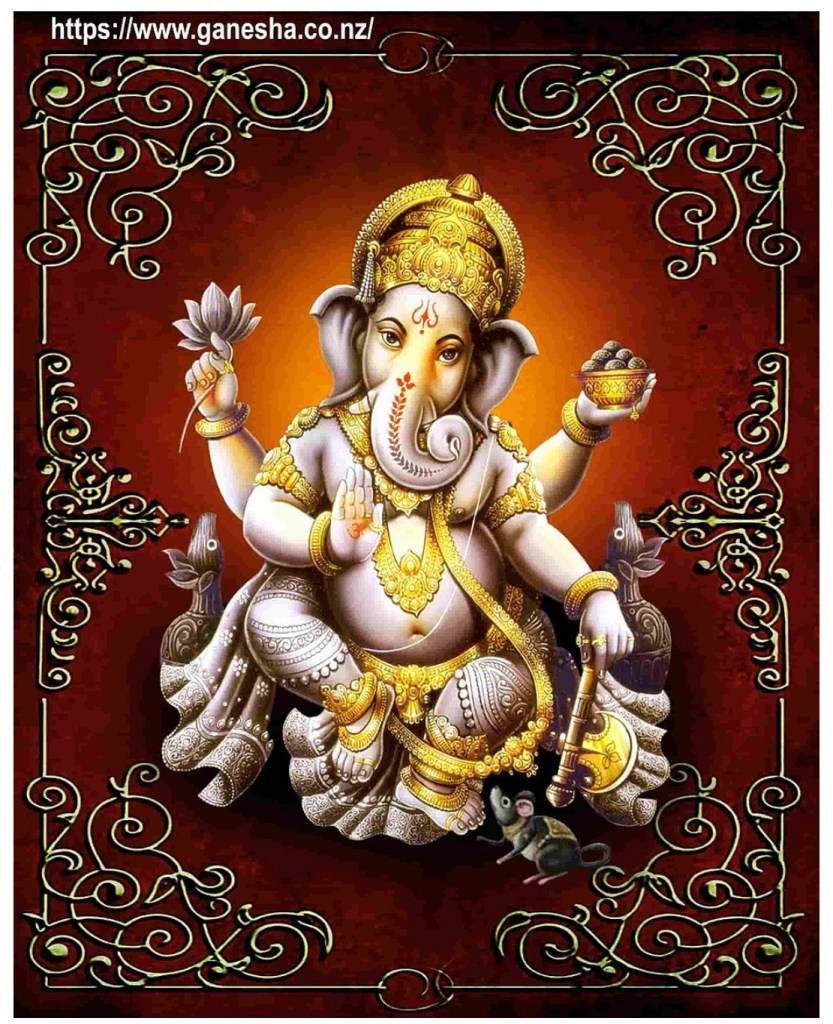
Uttara Ashada is symbolized by the broken tusk of Ganesha, the elephant-headed deity in the Vedic pantheon who is the giver of boons and overcomer of obstacles.
Ganesha was a scribe who lost his head to greedy bandits (a metaphor for the ego). Brahma had essential work for Ganesha to do and when an old elephant offered his head to Brahma, the Supreme Creator used the gift to restore Ganesha to life.
Grateful for a second chance, Ganesha dedicated his life to helping others reclaim their wills and overcome the seduction of destructive forces from the ego.
Chosen to write down the Vedas as the great Rishi (sage) Vashishta chanted them, Ganesha had the misfortune of his last quill breaking in mid transcription. The sage insisted he find a solution immediately or Vedic wisdom essential to life would be forever out of reach of humanity. Recognizing the truth in this imperative, Ganesha snapped off his tusk at great pain to himself in order to have an indestructible quill for completing the work.
This selfless sacrifice gave him the unstoppable victory of fulfilling his commitment to repay the gift of life, honoring the sacrifice of the old elephant, and immortalizing Ganesha as one of the most beloved avatars of creation.
So today, remember the gifts you have received and pay them forward, not to earn fame and fortune, but to gain the unstoppable triumph of will over ego. Measure all desires against need and always privilege the higher truth over base wanting. Namaste 🙏
Two monks are arguing about a flag. One says, “The flag is moving.” The other, “The wind is moving.” A third walks by and says, “Not the wind, not the flag; the mind is moving.”
A few years back I attended a Zendo, a Buddhist meditation retreat. During the three days of the retreat each of us had the opportunity to spend a few minutes in private conversation with the Roshi, the Zen master leading the session.
When my turn came, I found myself alone in a chilly room, bowing and sitting cross-legged on the bare floor. Roshi Pat sat on a low platform across from me. He was on a cushion with his long robes covering his legs, but I assumed or at least imagined him in full lotus. His unblinking eyes looked at mine and he asked me to tell him about my practice.
I shared that I began to practice to ease my anxiety about dying. He said, “You fear death,” more as an affirmation than a question. I nodded and weakly said yes. “ What about death frightens you?” he asked.
“Extinction. Being erased, gone forever.”
He tilted his chin upwards and his eyes seemed to penetrate more deeply into my own. “Well, what if that is all there is?”
“What?” I’d heard him but was stunned by the bluntness both of the question and his tone.
“Think about that,” he urged. “How will you live?”
It took several years of thinking on this question before I had a momentary insight. If I am living in fear of an inescapable event then I am already extinct. Any meaning my life is to have will be the result of what I do between this moment and the uncertainty of the inevitable departure from this body, this life. The courage to aspire, to help others, to grow in wisdom and experience is always there. I began to strive to act, even in fear, in order to show courage and create some temporal meaning amidst the possibility of meaninglessness. The work continues but I am no longer fearful of extinction. There are no guarantees, there is just now.
I remember this scene often when I am anxious or upset by the state of the world. This year, watching the very foundation of most of what I felt was safe, certain, and forever about being born a citizen of the United States be undermined, desecrated, and repurposed to fit the narcissistic desires of one person, aided and abetted by the largest collection of greedy, heartless courtiers and with the terrified and angry acquiescence of half the country’s population has rekindled that existential crisis in me, and not just for myself but for the whole of humanity.
There is some new foundation crack every day, another structure once considered impregnable breached, and even when I think these egregious despotic actions have reached their lowest possible expression, the cruel actors in this unfolding tragedy find a way to sink still lower.
So today I found myself again hearing the voice of Roshi Pat. How will I live when I am powerless to stop the destruction and desecration of the ground upon which America, my America, had grown to be what felt like a true beacon of hope, not perfect but in great measure always striving?
I am going to create meaning, at least for myself. This little essay is a step toward that. And I pose this question to any who are now living in fear. How will you live if the worst you can imagine is true? Think about it. You have almost limitless, untried choices.
The who, what, where, when, why, and how of this site
At Home in the Universe
I’m Stephen Russell, Vedic Astrologer and student of Dr. David Frawley, available to assist you with a range of services based on the ancient practice of Jyotisha Vedanga or Vedic Astrology.
Jyotish originated more than 5000 years ago on the foothills of the Himalayas in northwest India. There, on the banks of the Saraswati River, rose a civilization that would transmit to the world Jyotish, Yoga, Ayurveda, Vastu, and other Vedic Sciences. From the earliest iterations of the ancient Rishis to the present day, the practice of reading the energetic movement of matter and the concurrent events, possibilities, and challenges represented by the patterns formed has benefited countless generations of seekers toward expanded consciousness and transcendent wisdom.
I first became aware of Jyotish — sometimes called Vedic Astrology — in 2017 when my wife gifted me with a birthday reading from a Jyotishi. The information proved unexpectedly helpful as I faced significant changes and challenges in my physical, mental, emotional, financial, and spiritual state. Seeing the benefits almost at once, I undertook to learn how to read the patterns and movement in my Vedic Chart for myself. Eventually, I met others who had an interest in personal improvement and were willing to learn and grow with me. Some are students, some practitioners, the majority are simply people interested in getting the most out of themselves and the time of their lives.
I began studying Dr. David Frawley’s Ayurvedic Astrology course through the American Institute of Vedic Studies in early 2018 and received my certificate of successful completion in July 2020. I retired from a long career in management in September 2018 and now spend my time learning and consulting as a Vedic Astrologer, teaching an online literature course, and continuing to explore the connections between living energy and matter. I believe my goal is the same as that of the universe, to move and grow toward a state of balance, unity, expanded consciousness, and ultimate freedom. For individuals seeking to make sense of this many-faceted cosmos wherein all life is found, Jyotisha Vedanga, the science of light, exists as an extraordinary helpmate.
This site operates as a point of contact for those seeking to better understand their own lives, their place in space and time, and the opportunities, benefits, challenges, and lessons of experience and awareness from this lifetime and beyond. Here are links to the paid services I offer, access to free information about Jyotish via this blog, and soon to come a library of both free and paid resources for those interested in becoming Jyotish practitioners both for themselves and others.
Like most wisdom, the learning never ends in the Vedic Sciences. The discoveries of the past fifty centuries are really just restatements of the source and substance of creation, growth, depletion, and renewal. Availing ourselves of this wisdom allows us to do our part in the endless cycle of life as we seek freedom through understanding and aligning with the twin forces of karma and dharma.
Today, August 18, 2024 there’s a very powerful astrological pattern. The moon, the south node and Jupiter form a grand trine in the lunar signs of Shravana, Hasta, and Rohini. Just as the sun signs draw power from their rulers the moon signs do likewise, and these three are the three of the 27 moon signs that draw their power from the moon.
In the Vedic astrological system Jupiter aspects both the south node whose name is Ketu in Vedic astrology, and the moon, and Jupiter is a planet that brings expansion and abundance to whatever qualities are expressed by the planets and the signs that it aspects. Jupiter is the guru the teacher, the one that helps us to transcend the realm of the senses and takes us to learning about that which is beyond what we can perceive.
Jupiter is in Rohini, the moon’s favorite sign. It is the star of ascent. It is the star that helps us to conceive of something new, to create it in the world, and nurture it so that it grows to bear fruit in our lives. It’s symbol is a chariot. Chariot rides are very fast, very exciting, and sometimes have a slight element of danger. Being intentional with your purpose as you interact with this energy is sure to bring a positive result.
The moon in Shravana is connected to what is called the divine ear or the listening ear and in its highest aspect it allows us to go deep within, to still the senses, to meditate, to chant, or to simply sit and breathe and hear wisdom that has been waiting to break through from our unconscious, sometimes for decades.
Ketu represents shadow energy. It hides the sun, it hides the external world. It hides reality from us, but connects us much more deeply to our inner feelings, to our emotions, to our memories and to our intuition. In Hasta, Ketu is in the star that puts that which we desire into our own hand.
So this is a very fortuitous combination and one that doesn’t occur that often considering Jupiter takes 12 years to complete its cycle and will only return to Rohini in 2036. Ketu takes 18 years to complete its cycle and will only return to Hasta in 2042 and of course, the moon cycles once a month through all 12 signs.
Take some time today to sit quietly, to close your eyes, to take some deep breaths, and then to sink down into the realm below the senses. Focus on a mantra, even something is simple as Om, or focus on your breath, or the flame of a burning candle, all of these can draw you deeper into yourself. If there are questions, you’ve been seeking answers to or there are mysteries you’ve been pondering, or everything is going well, and you simply wonder what might happen being under the influence of this auspicious placement and acting in accordance with it, today is the day to get answers.
Even 10 or 15 minutes could bring up life-changing answer, ideas, or insights.
Astrology is built on observations over tens of thousands of years across all cultures. That it continues to be popular, speaks more than any scientific inquiry to the effectiveness of the stories, the myths, the legends, but especially the life experiences of those who have been observers of this extraordinary, powerful practice .
Ketu connects us to past life karma and will resist new activity until we have cleared our debts with the past. The greatest debt we often have is to ourselves, to let go of shame, to release, anger and sorrow through honest expression of feelings, and to move forward understanding, we are connected to all of life in its attempt to create harmonious growth of consciousness.
Astrologers often point to Retrograde planets for creating an assortment of personal woes . This post will help you to better understand the reality of retrograde and offer a way to handle these frequently troubling periods.
What is a retrograde planet? When viewed from the earth planets typically rise in the East and set in the West just as the Sun, Moon, and stars.
Like the Moon and Stars, watching planetary movements over time usually shows they rise a bit earlier in the evening which means they appear to be a bit further west when viewed at the same time over a period of months until they eventually appear low in the western sky after sunset before disappearing for brief periods only to appear prior to sunrise in the east a few weeks or months later. They then rise earlier each morning until eventually they are setting as the Sun rises and shortly after they rise in the east at sunset to begin the cycle anew.
During retrograde periods this behavior changes for a period of time. The planet, instead of rising earlier and tracking increasingly westward each night will come up later for weeks or months. It appears to be moving further east day by day. Eventually the retrograde motion stops and the planet resumes its normal appearance.
What causes retrograde motion? It’s not so much a cause as an effect resulting from the perspective we have on planets from the earth. All of the visible planets rotate on the same plain with the sun at the center.
Image not to scale
As the earth rotates on its axis in a counterclockwise direction when viewed from above the North Pole, any visible planet as well as the Sun appear to rise in the east and set in the west.
Because the earth and the visible planets all orbit the Sun in a clockwise direction they all have a gradual east to west motion from night to night.
However, a retrograde planet will appear to slow in its movement, stop for a day or two, and then retrace its steps for a time before slowing, stopping, and resuming its normal direction.
For planets closer to the Sun (Mercury and Venus) the retrograde period occurs each time these speedy planets overtake and pass the earth on the same side of the Sun. For the outer planets (Mars, Jupiter, and Saturn) retrograde is produced by the earth overtaking these slower moving planets.
This illusion is produced by the rotation of the earth and the fact that seeing planets in a straight line view when they are traveling a circular path means the have further to travel than the view reveals. The relatively constant speed of the earth’s rotation places these planets further east at the same time of day until the pass is complete.
What are we conclude from this? Retrograde occurs when a planet is either overtaking or being overtaken by the earth. In other words, during retrograde periods a planet is at its closest point to the earth and that means it’s ability to transmit reflected light and other energies is at its peak. Retrograde planets in a word are STRONGER than planets moving directly.
Astrologically speaking, planets are the energetic sources that activate the qualities of the Sun signs in the directional houses of an astrology chart. The effects produced depend on two factors: the relationship between the signs, planets, and activities in an individual’s chart and the skill and choices the individual makes when participating in the activities during the retrograde period.
Let me give a mundane example.
Venus is a planet that connects most powerfully with the latter degrees of Pisces, a sign that offers infinite choices for transforming one’s life. If Venus is retrograde as it moves through the last half of Pisces and Pisces locates in a person’s house of career, then a useful tool for making a career change is online and available.
However, a person who is failing in their present career may very well bring the same problems to their new career if they change without addressing the internal and external issues harming their current situation. A retrograde Venus could cause such a dramatic and sudden change the person is overwhelmed by their lack of preparation.
Pisces is also a sign that gives many choices without giving much help as to which choice is best. The strong Venus may give an individual prone to overreaching some early success in the new career until the responsibilities of the role overwhelm their nature. Or it may simply stoke impossible ambitions leading to constant failure and frustration. Or for a person caught in the memories of past successes it might send them into a stasis of seeking to recreate a world they long ago left behind.
The retrograde planet didn’t initiate any of these situations. The choices made by an unprepared individual to act under the strength of the retrograde planet brought about the unfavorable result. The message here should be clear but many living under the delusion of having no agency in the face of overwhelming planetary power will miss it.
Here it is: Retrograde planets are STRONG. Not good or bad any more than a new car battery is good or bad. Used properly with preparation, planning, and purpose in a well maintained vehicle, the new car battery provides reliable starting power under many conditions. Hooked up improperly or to a poorly maintained car, or to a vehicle the battery isn’t designed for, at best produces limited results and at worse could seriously damage the vehicle or the person or persons using it. The same is the case with retrograde planets.
Since we are currently experiencing a retrograde Venus in Leo, consider the possible effects carefully. Leo is a creative organizer, a fixed fire sign meant to promote growth and health when we have the right resources, arrangement, plan, and skill to draw on it. Depending what house Leo occupies in your birth chart you have an opportunity to repair, preserve, or grow your life in the activity of that house.
Only a comprehensive understanding of your whole chart will give you all the information needed to make the best choices under this condition. A professional Vedic Astrology reading can provide that information. The rest is up to you!
Astrologers often point to Retrograde planets for creating an assortment of personal woes . This post will help you to better understand the reality of retrograde and offer a way to handle these frequently troubling periods.
What is a retrograde planet? When viewed from the earth planets typically rise in the East and set in the West just as the Sun, Moon, and stars.
Like the Moon and Stars, watching planetary movements over time usually shows they rise a bit earlier in the evening which means they appear to be a bit further west when viewed at the same time over a period of months until they eventually appear low in the western sky after sunset before disappearing for brief periods only to appear prior to sunrise in the east a few weeks or months later. They then rise earlier each morning until eventually they are setting as the Sun rises and shortly after they rise in the east at sunset to begin the cycle anew.
During retrograde periods this behavior changes for a period of time. The planet, instead of rising earlier and tracking increasingly westward each night will come up later for weeks or months. It appears to be moving further east day by day. Eventually the retrograde motion stops and the planet resumes its normal appearance.
What causes retrograde motion? It’s not so much a cause as an effect resulting from the perspective we have on planets from the earth. All of the visible planets rotate on the same plain with the sun at the center.
Image not to scale
As the earth rotates on its axis in a counterclockwise direction when viewed from above the North Pole, any visible planet as well as the Sun appear to rise in the east and set in the west.
Because the earth and the visible planets all orbit the Sun in a clockwise direction they all have a gradual east to west motion from night to night.
However, a retrograde planet will appear to slow in its movement, stop for a day or two, and then retrace its steps for a time before slowing, stopping, and resuming its normal direction.
For planets closer to the Sun (Mercury and Venus) the retrograde period occurs each time these speedy planets overtake and pass the earth on the same side of the Sun. For the outer planets (Mars, Jupiter, and Saturn) retrograde is produced by the earth overtaking these slower moving planets.
This illusion is produced by the rotation of the earth and the fact that seeing planets in a straight line view when they are traveling a circular path means the have further to travel than the view reveals. The relatively constant speed of the earth’s rotation places these planets further east at the same time of day until the pass is complete.
What are we conclude from this? Retrograde occurs when a planet is either overtaking or being overtaken by the earth. In other words, during retrograde periods a planet is at its closest point to the earth and that means it’s ability to transmit reflected light and other energies is at its peak. Retrograde planets in a word are STRONGER than planets moving directly.
Astrologically speaking, planets are the energetic sources that activate the qualities of the Sun signs in the directional houses of an astrology chart. The effects produced depend on two factors: the relationship between the signs, planets, and activities in an individual’s chart and the skill and choices the individual makes when participating in the activities during the retrograde period.
Let me give a mundane example.
Venus is a planet that connects most powerfully with the latter degrees of Pisces, a sign that offers infinite choices for transforming one’s life. If Venus is retrograde as it moves through the last half of Pisces and Pisces locates in a person’s house of career, then a useful tool for making a career change is online and available.
However, a person who is failing in their present career may very well bring the same problems to their new career if they change without addressing the internal and external issues harming their current situation. A retrograde Venus could cause such a dramatic and sudden change the person is overwhelmed by their lack of preparation.
Pisces is also a sign that gives many choices without giving much help as to which choice is best. The strong Venus may give an individual prone to overreaching some early success in the new career until the responsibilities of the role overwhelm their nature. Or it may simply stoke impossible ambitions leading to constant failure and frustration. Or for a person caught in the memories of past successes it might send them into a stasis of seeking to recreate a world they long ago left behind.
The retrograde planet didn’t initiate any of these situations. The choices made by an unprepared individual to act under the strength of the retrograde planet brought about the unfavorable result. The message here should be clear but many living under the delusion of having no agency in the face of overwhelming planetary power will miss it.
Here it is: Retrograde planets are STRONG. Not good or bad any more than a new car battery is good or bad. Used properly with preparation, planning, and purpose in a well maintained vehicle, the new car battery provides reliable starting power under many conditions. Hooked up improperly or to a poorly maintained car, or to a vehicle the battery isn’t designed for, at best produces limited results and at worse could seriously damage the vehicle or the person or persons using it. The same is the case with retrograde planets.
Since we are currently experiencing a retrograde Venus in Leo, consider the possible effects carefully. Leo is a creative organizer, a fixed fire sign meant to promote growth and health when we have the right resources, arrangement, plan, and skill to draw on it. Depending what house Leo occupies in your birth chart you have an opportunity to repair, preserve, or grow your life in the activity of that house.
Only a comprehensive understanding of your whole chart will give you all the information needed to make the best choices under this condition. A professional Vedic Astrology reading can provide that information. The rest is up to you!
Bhagavad Gita Background from the Mahabharata Epic
1. The Kauravas are the blind king Dhritarashtra and his 100 sons.
2. The Pandavas are Dhritarashtra’s younger brother Pandu and his five sons.
3. Seeking to possess all of the ancestral property, formerly shared between them, the Kauravas challenged the Panduvas to a rigged game of dice. The eldest Pandava brother accepted the challenge, not knowing the game was rigged.
4. After losing the Pandavas were exiled to the forest for 12 years and then required to return but remain incognito for an additional year or face another thirteen year period of the same. Only by completing the cycle successfully could they reclaim their inheritance.
5. At the end of the cycle, the Pandavas sent Lord Krishna to the Kauravas to reclaim their birthright.
6. The eldest Kauravas son, Duryodhana, insulted Krishna and declared he would not give up so much as a needle-point of ground unless the Pandavas took it by force.
7. Krishna and Pandava brother Arjuna went to Duryodhana to try and negotiate a peaceful settlement. When it became apparent war was inevitable, Krishna proposed that he would grant one side a superior army and the other would have him as a counselor and observer, but in no way would he fight on either side.
8. Giving both sides time to consider his offer he fell asleep.
9. When he awoke, arrogant Duryodhana had taken a position on his level, standing before the great Lord, so Krishna would see him first, hoping to be given first choice—he wanted the superior army.
10. Arjuna was prostate several steps below Krishna’s resting place in obeisance. Krishna ignored Duryodhana and offered Arjuna the first choice. To Duryodhana’s delight Arjuna immediately asked for Krishna as counselor to the Pandavas, giving the superior army to the Kauravas.
11. The battle was to take place on the holy plain of Kurukshetra. The Pandavas would be led by Dhristaduyumna, brother-in-law of Arjuna (and in a strange incestuous twist, of all five Pandava brothers), a ferocious warrior trained in combat by the leader of the Kauravas, grand sire of the Kuru family, Bhishmacharya.
12. On the eve of the battle, the great sage Vyasa (author of the Vedas and father of Dhritarashtra in some texts) came to blind Dhritarashtra and offered to restore his sight that he might witness the fighting, a war that seemed heavily weighted toward the vastly superior numbers of Kauruvas, including all 100 brothers. Dhritarashtra declined, saying he would prefer to hear news as it progressed.
13. Vyasa gave Dhritarashtra’s charioteer and chief adviser Sanjaya the gift of Divine sight, that he might report events at Kurukshetra to his blind master while the king remained safely in his palace.
14. For ten days the battle raged with the Kauravas killing one hundred thousand Pandava warriors before Bhishmacharya was killed and … I’ll save the outcome for later as it is in the Mahabharata that the actual fighting unfolds.
15. After the tenth day, Dhritarashtra summoned Sanjaya for news from the battlefield. Sanjaya’s report makes up the 700 verses of the Bhagavad Gita.
See the previous post BUILDING A FOUNDATION OF LEARNING to participate in these free online lessons for learning the basics of Vedic Astrology. Click below to read that post.
Outline of this Section to be presented in 3 Lessons.
Two different ways of calculating the Zodiac – Tropical and Sidereal / Understanding the relationship between Astronomical Maps and Astrological Birth Charts as moments in time and space.
Creating birth charts – Required information and decisions to consider for beginners / The effect of using date, time and place of birth; effects of an inaccurate birth time; methods of clarifying an official birth time; options for a reading when the birth time has been lost.
The BIG 3 in both the North and South Indian systems / A metaphor for understanding the role, prioritization, and differences between Signs, Houses, and Planets / Why we might choose one system over another.
LESSON ONE – TWO ZODIACS BASED ON METHOD OF CALCULATION
The above image is an antique Planisphere or map of the Northern and Southern hemispheres of the night sky centered on the poles. Modern planispheres have rotating disks that extend outside of the starfield and allow the user to set the date and time in order to establish which direction to look in order to see any specific object. These maps have been used by skywatchers for centuries and modern versions exist as apps that we can carry on our mobile devices. Planispheres are primarily used for identifying constellations, bright stars, and sometimes distant galaxies as well as our own Milky Way. Generally, the printed versions do not have planetary placements but the digital forms often have the whole vault of the sky represented in real time including all of the known planets.
An astrological chart is another form of sky map, focused on the ecliptic, the path the sun travels each year, as viewed from the location of the person or event whose chart we are looking at. The placement of all twelve sun signs, including those hidden below the horizon along with the planets, sun, moon, and the two eclipse points will be indicated. In addition, mathematical points that have special meanings in astrology may also be indicated on the astrological chart.
The birth chart, then, is a symbolic representation of the twelve sun signs in relation to the planets according to the date, time, and place of birth. It is not meant for navigational purposes and is only partially useful for star or planet gazing. Astronomically, it could serve as a rough calendar based on placements of the sun and moon and here we find the first significant difference between the Vedic and Western System.
The images above represent two ways of laying out the Zodiac, the twelve constellations the Sun travels through in a year along the yellow oval called the ecliptic. The upper graphic is the Sidereal Zodiac. It is what is used in Vedic Astrology. The blue oval represents the earth’s equator extended outward to where it intersects the ecliptic at two points on opposite sides of the Zodiac. Sidereal calculation takes account of the known wobble in the earth’s axis of rotation that causes the equatorial intersections to move backward through the Zodiac in a cycle of 24,000 to 26,000 years. This happens because the equator is always at 90 degrees to the polar axis so the wobble (like a top slowing down) changes the intersection point of the equator by one degree approximately every 72 years.
The lower graphic is the Tropical Zodiac as calculated by Greek astronomers approximately 2000 years ago. Although the Greeks probably knew of the wobble in the earth’s axis they did not take it into account in setting up Western Astrology. Consequently, the equator’s intersection point is always said to be at zero degrees of Aries on one side of the Zodiac and zero degrees of Libra on the opposite. These points are the Equinoxes, where the Sun’s crossing puts it directly over the equator at the beginning of Spring and Fall in the Northern Hemisphere (with the seasons reversed in the Southern sky). For this reason, Western Astrology, as established by the Greeks always states that the Sun enters Aries on the first day of Spring and Libra on the first day of fall.
In truth, based on the slow rotation of the wobble, the Sun currently enters Aries on April 14 and Libra on October 15. The equinoxes still happen in March and September but the Sun is actually just shy of 6 degrees Pisces on the first day of Spring and 6 degrees of Virgo on the first day of Fall in the Northern Hemisphere. This accounts for the 24 degrees of backward movement since the time of the Greeks. Vedic astronomers were aware of this wobble and figured it into all of their calculations centuries and possibly millennia before the Greek Zodiac appeared.
Sidereal astrology uses the actual placement of stars and planets against the constellations rather than basing their locations on a location that was accurate 2000 years ago. For this reason, five out of six people have their Sun Sign in the preceding one from what is commonly presented in Western horoscopes. This is not meant as an indictment of the accuracy of Western Astrology. Just as the placements are calculated differently so too are the meanings attributed to the planets and signs in the Western school different. Both systems work for studying astrology in their own way. However, understanding that unless you were born between approximately the 15th and 21st day of the month following what you identify as your Western Sun Sign, the Sun was actually in the one preceding it in the Vedic system.
To give an example. I was born on the 11th day of June, with my Sun in Gemini according to Western Tropical Astrology. But the Sun actually is located in Taurus in my Vedic chart and that is actually where it was on the day I was born. It didn’t enter Gemini until three days after my birth.
Unlike a Planisphere, which shows the whole map of the sky and uses rotating outer disks to establish directions (East, North, South, and West) based on date, time, and place, a birth chart will show the locations of planets based either on the tropical or sidereal zodiac. Placing planets within constellations, birth charts take into account the latitude and longitude of the birthplace. This makes a person’s birth chart unique. Many charts can look similar or even the same but precise measurement in degrees, minutes, and seconds (all measures of distance in celestial navigation) reveals the differences. In Vedic astrology, these minute measurements, based on the exact location of celestial objects relative to the Zodiac and ecliptic, make a crucial difference in differentiating individuals as we work with the chart and reports generated from them. This will be explained in future lessons.
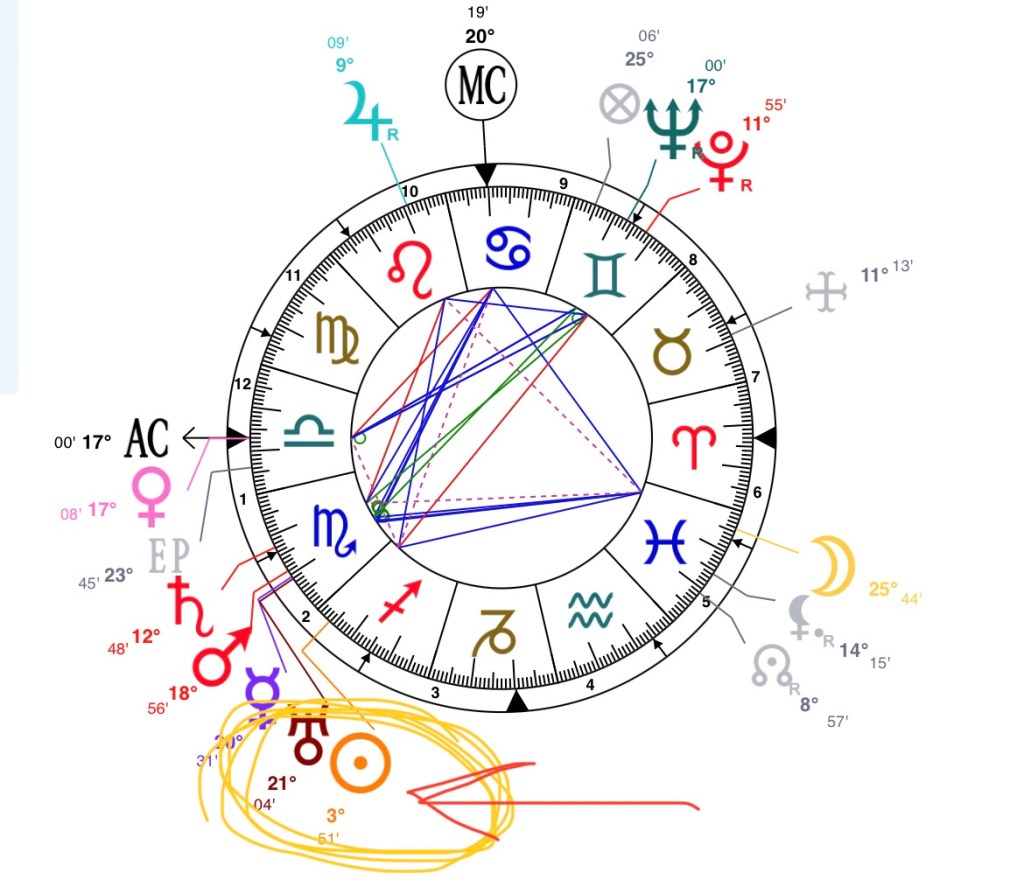
To end this lesson, the image below shows two birth charts for AA Founder Bill Wilson, one a Vedic Sidereal chart in the North Indian style and the other a chart calculated using Tropical methodology. Note the difference in the Sun’s placement as indicated by the red arrow.
In the Vedic chart (blue) the Sun is at 11 deg 26 min of Scorpio. In the Western chart (circular) it moves to 3 deg 51 min of Sagittarius, a difference of 22 deg 25 minutes.
Bill Wilson’s Vedic Natal ChartBill Wilson’s Western Natal Chart
This difference between the Tropical and Sidereal Zodiac is called the Ayanamsha and increases each year by 48-52 arc seconds due to the wobble in the earth’s axis. As of 2010 the Ayanamsha was 24 degrees, putting the Sun’s actual location at 6 degrees of Pisces on Spring Equinox. Please keep in mind it is not just the Sun moving. The entire system of planets must relocate based on the Ayanamsha. Planets in high western degrees (24 and above) will remain in the same sign. Those below the degree of change will fall backwards.
If you received a birth chart from me, please look at the placement of the Sun for comparison. Did your sign change from the one you commonly identify with? If so, consider what that might mean for understanding your life. There is no right or wrong answer here, but when a paradigm is affected by new information, our sense of who we are based on that paradigm is generally altered. I know that for me moving from Gemini to Taurus, even if I didn’t fully understand the meaning at the time, initiated a major shift in my thinking.
Gemini operates from a language based approach to life. This means it is words that create meaning and engagement for Gemini. Taurus is slower to attach to a life experience, needing time to think through what is being presented and examine it from a practical standpoint. Gemini is flexible and often impulsive, using words to fill out gaps created by its quick intellectual grasp of new material. Taurus compares new experiences to the rules it believes govern life. Until it sees a practical fit, it remains thoughtful rather than engaged in action.
Feel free to discuss your thoughts on this lesson in the comments.
When I established this page in 2021, one of my goals was to empower readers with fundamentals of Vedic Astrology so they could begin to use the principles in their lives. Keeping in mind that Jyotisha Vedanga (Sanskrit for the Science of Light, the original form of this practice) began as an attempt to manage reality through the creation of a calendar, I believe that anyone willing to suspend their disbelief for a year can learn enough to receive benefits of relating planetary movement to quality of life. The benefits accrue through a combination of personal experience aligned with concurrent planetary positions of the past applied to present and possible future situations.
To give an example: Most of us have likely experienced a situation at home, school, or work like the following. You have an important deadline to meet with a high quality standard attached to it. This might be an assignment in school, a project or task on the job, or a responsibility at home requiring preparation, planning, and skillful execution. Something happens that interferes with proper preparation and suddenly the deadline is upon us. We do our best but are certain that our efforts are doomed to failure. Yet, for reasons we cannot explain, the outcome exceeds the most outlandish expectations we ever had despite our not doing what all would agree was essential work. Conversely, in a similar situation we prepare to the nth degree and complete the activity on or ahead of time at a level of quality we are confident will earn all of the merit we attached to the project. But, again inexplicably, the results are mediocre or worse, a complete failure.
Situations like this and the subtle energies that underpin them are exactly what metaphysical practices are designed for. Concurrences and coincidences when they repeat predictably even with no physical cause or so-called “hard evidence” have an unmistakeable ring of truth once we let go of our learned skepticism.
I didn’t accept this the first time or even the five hundredth time I heard and witnessed such things, but over time I have come to realize that “Who, What, Where, and When” of any experience concurrent with any repeated pattern in the metaphysical world are likely to be subject to energetic causes that are beyond our capabilities to measure or even to understand. The “Why and How” remain out of reach except as myth, legend, or metaphysical conclusion. Nonetheless, as Aristotle once noted in his essay on Concurrence and Coincidence, “Just because we don’t understand the mechanism operating in such matters doesn’t make them any less real, especially when we directly experience them.”
A fisherman in ancient India didn’t need to know that the tides were the result of gravitational effects involving the Sun and Moon. The “supernatural” story of a form of incomprehensible power inhabiting or acting on the waters and causing them to rise and fall in a predictable patterns was more than sufficient for the boats to launch and return with the tides, making the journey to and from the fishing ground more efficient. Understanding the concurrence of Solar position and Moon placement was sufficient to generate effective time tables regardless of the operating mechanism.
To that end, I am going to use most of my future blog posts to lay out what I hope will be an interesting and informative foundation for anyone interested in learning the basics of Jyotisha Vedanga (Vedic Astrology) to a degree sufficient to understand its usefulness for one’s own life. I will also be happy to provide a basic birth chart for anyone interested in applying the lessons to their own life. The chart will be provided at no charge. Participants will be able to post questions about their chart as it relates to each lesson and I will answer as many as time permits provided that they are related to the lesson and I have your permission to share the question and answer publicly on this blog, my social media pages dedicated to Jyotish, and as examples in future lectures or postings I may create as part of my professional practice. I will conceal all personal informtion as to your name and birth data (full date, time, and place) but will need to be able to put up the chart, the question, and my answer.
Private consultations about individual charts will be provided for a fee upon request. The only thing I am providing for free is a basic Vedic birth chart.
By the time a year of lessons are completed participants should know the basics of reading both North and South Indian Charts, differences between Vedic and Western astrology, how to track the movement of planets against their birth chart, and a variety of techniques for applying the data they collect on their personal charts to their individual lives.
One of the most important roles I have as a professional astrologer is to empower each person to become their own practitioner at a basic level, that is, to understand the tools you came into life with as represented by the signs, the power sources for operating those tools via the planets, and the affects produced by choosing different tools and power sources in relation to the timing of life lessons, opportunities, and challenging situations.
Many of us have said at least once that we wished humans were born with an operating manual. By learning to read the Vedic birth chart over time, you might come to believe, as I have, that such a manual exists written large in the movements of planets, the sun, moon, and eclipse points against the background of fixed stars.
Stay tuned for the first lesson, “Elements of a Vedic Astrology Chart,” coming soon. If you want your free birth chart to use for your own learning experience, email me directly at stephen@jyotishamerica.com. You will receive a response from me within 5 business days.
On this Thanksgiving holiday my prayer is for an awareness of how miraculous life is and how important each of us are to the collective continuity of the processes that support all of Life.
As I write this a stellium of planets (Venus, Mercury, Moon, and Sun) are in Scorpio. That brings the Source and sustenance of life, the Sun, into the sign of gathering all energies available to us and holding it until the inherent wisdom unfolds the best use of each energetic element. Scorpio acts strategically, constantly assessing the moment against past experiences in order to conserve its strength for times when strong action will have the greatest positive impact on the overall Life process. Actions of gratitude for Life and the lives we are privileged to be near are strongly supported today.
Of the other three planets in Scorpio, Venus wins the “planetary war” with Mercury bringing discernment, a sense of authenticity, desire for comfort, joy, and pleasures of association with loved ones. Mercury, curious and impulsive, slows enough under Sun/Venus influence to bring out its idealism and enthusiasm for life. This infectious and youthful joy is perfect for celebrating with those we love.
Moon is still depleted but in a day or two will gather strength to brighten toward the December full Moon in a couple of weeks. Saturday May be a better day to get out into the early holiday bustle compared to Friday.
There is a full Mars and Jupiter aspect on Scorpio. Mars is retrograde in Taurus, linking it to Venus (Ruler of Taurus) to help us take practical action. Consider needs versus wants and especially needs of others over personal desires to use Mars’s enormous retrograde strength for good karma.
Jupiter in its own transformative sign of Pisces brings unlimited possibilities for expansion but needs help understanding the difference between aspirations that are fantasies and those with imminent possibilities for manifesting. One area that is always available to grow and bring transcendent healing is through kindness toward others and ourselves.
I’m thankful today for all who have followed these postings this past year, and for the many among you who have allowed me to read your Vedic charts and share the gifts of Life as seen in the nature we are all part of.
Happy Thanksgiving to all the living beings everywhere.
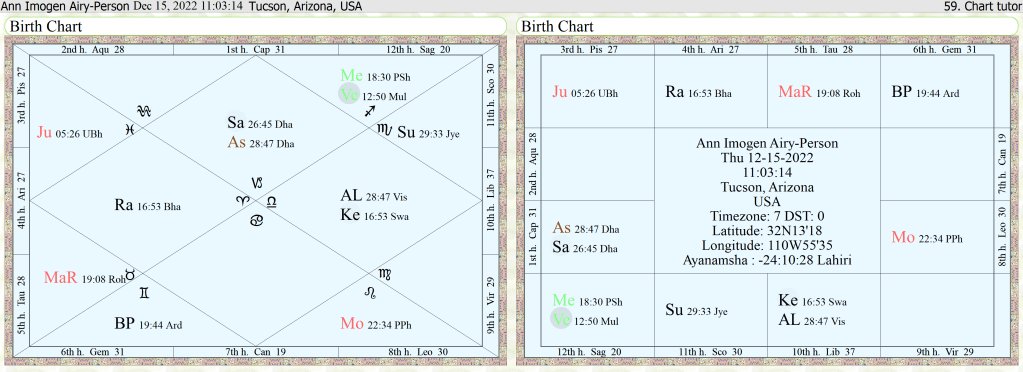
A typical response to retrograde Mars (MarsRx) might be something like the title of this post.
In our culture many people associate retrograde planets with expansion and increase of life’s mundane hardships.
Mercury retrograde gets the credit or blame for mechanical and communication incidents. When disruptions to the technological side of existence leave us tongue-tied as we hit CTRL-ALT-DEL on our frozen devices over-and-over some sympathetic onlooker cheers us with, “Well, you know, Mercury retrograde. Shame, really.”
And there’s nothing like a VenusRx to bring up old injuries of the heart, making truth and trust bleed as scabs and scars get swept away in the long memories of our traumatized histories. “I don’t care if it’s been fourteen years. I still feel so violated.”
Jupiter’s Rx progressions often teach us what too much of a good thing really feels like, while Saturn in Rx patiently squeezes every drop of moisture from the foundations of our selfishness and externalized excuses for not behaving more kindly and patiently toward one another and ourselves.
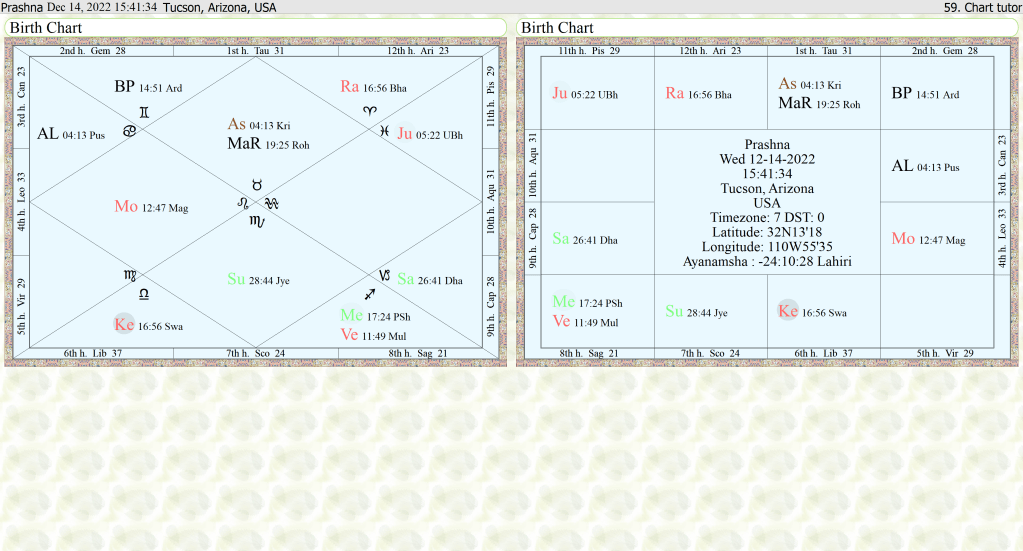
But for purely dramatic force acting suddenly, with all the subtlety of a Roman Legion marching on hapless defenders of untenable positions, MarsRx lights up the sky like no other planet. And yes, Mars just went retrograde on October 30, 2022.
Start the countdown, because in the USA it’s election season followed by the year-end holidays in a cultural moment that is anything but calm. Mars Rx continues until January 12, 2023 and for the unaware it might be a wild ride.
For those who follow the sky and understand the concurrent effects (note I said concurrent, not causal!) it’s a great opportunity to find the practical in the curious, the higher organization contained in chaos, and a level of creative intelligence that can fire up the engines of strategic, conscious action in protective waves that allow for stabilization of fault lines in the mind and body even as the whole planet sometimes feels like it is breaking apart.
The real opportunity in facing retrograde energy is to understand who is really responsible for the moment-by-moment events in our lives. Hint: it isn’t any external force, not even planets.
Retrograde planets when seen from the earth appear to slow in their passage across the background of constellations before stopping and reversing course for a period of time. Then a second slowing and stopping, another reversal, and the resumption of forward motion. The visible effect is of the planet passing over the same part of the constellations three times before continuing onward.
The effect is to intensify and concentrate the subtle energies over a specific set of activities (based on the house of an individual birth chart) as well as a broader effect on the natural houses of the signs the planet rules.
An example may help:
For an individual with an Aries ascendant Mars rules both the first and 8th houses. These are the houses of the self in the body as it incarnates and acts in the world (1st house), and the realization we will one day leave our body behind (8th house of mortality, mystery, and deep research). Because 1 and 8 are the natural order of the Mars-ruled signs the energy generated by Mars’s actual retrograde location (presently in Gemini where it stirs up curiosity, rapid intellectual understanding, flexibility, as well as possible boredom, mischief, and impulsive behavior involving aggression, anger, and even violence) the effects are most strongly felt in the 1st and 8th for Aries ascendant individuals.
I’ll cover effects for the remaining ascendants in subsequent posts as well as effects from the placement of the Sun and Moon. My real purpose here is to explain retrograde effects as temporary, and more importantly that even though things do get stirred up for a time these are still very subtle energies and therefore, for the most part deliver results that may be modified, strengthened or diminished by our individual response to them.
The greatest misunderstanding regarding modern people and their relationship to the planets is thinking planets are all powerful, especially when difficulties can be blamed fully on them rather than the truth: the difficulties are usually the result of our choices, our responses to subtleties we are either ignorant of or deny entirely. We always have responsibility for our lives even if it is only the ability to respond to situations as they occur. And it is usually the response that carries the greatest weight in measuring the effects of not only Retrograde but ALL planetary movement.
The key to responding under strong retrograde influences (MarsRx in Gemini and eventually Taurus beginning in the midpoint between a solar and lunar eclipse and under a waxing Moon is strong) is to be conscious of how we feel moment by moment so that our actions are choices made in full awareness of the possible consequences, and to act toward positive outcomes of kindness, compassion, and with full recognition that all of us are doing the best we can with what we know.
“Om, Ayeem, Hreem, Shreem, Kleem Mangalaya, Om Namaha!”








 American Vedic Astrology